China Social Media, SEO, China Business ConsultantPosts RSS Comments RSS

The Rape of the Nanjing Memorial

img_0296

“The ancient commission of the writer has not changed. He is charged with exposing our many grievous faults and failures, with dredging up to the light our dark and dangerous dreams for the purpose of improvement.”

John Steinbeck

Rape, torture, and war crimes are the twisted common tongue spoken by those falsely entrusted with humanely executing and conjugating wars humanely–if such a a mournful ideal is even possible.

I spent a week up north recently, most of the time in bed ragged from battling a relentless fever, and would have recovered sooner if not for my long climbs out of exhaustion to explore China’s City of Ghosts, Nanjing. I had studied diligently for decades the massacre branded incident by revisionist Japanese historians. I had to see the unresolved grief of a nation now shaped into a memorial and on display so the world will not forget the Asian holocaust and the 20,000,000 lives surrendered in Korea,  Burma, Taiwan, The Philippines, Thailand and the whole of the Pacific Rim enslaved by Japanese, greed, lust and an imperial megalomania.

The memorial hall, a coffin-like structure near the burial site of murdered Chinese (”Wan Ren Keng” or Pit of Ten Thousand Corpses) was built ostensibly to honor the memory the 20,000 women raped and some 300,000 citizens slaughtered in fewer than eight weeks of Japanese occupation. Some Japanese “negationists” dispute the number and others even label the talk of massacre a mere act of Chinese propaganda.

What is known, from diaries and collected records from such groups as the Red Swastika and ten other international aid groups, documented the burial of more than 150,000 remains in Nanjing. And I had expected the memorial to make heard the collective wail of a lost souls and a people humiliated beyond the darkest, most appalling horrors your imagination can conjure.

img_0290

I braced myself going in for a repeat of the suffocating, intense pain I felt when visiting the concentration camp at Dachau, the Holocaust Museum in Washington, DC or the Vietnam Memorial at Angel Fire New Mexico. These feelings never came. Maybe it was because I was unable to separate myself for any reflection from the constant ring of cellphones, or the it could have been the relentless manifestations of the number “300,000″ that seemed there more as a rebuke than a eulogy, or perhaps it was the theme park feel of the exhibits, the horrific English translations at each station. Too, I nearly drowned in rhetoric about the glorious defeat and surrender of the Japanese to the Chinese forces. The sprinkling of mentions of the Allied sacrifices in support of China were disappointing and infuriating. There was a single picture and only a brief mention of  fearless men, like Doolittle’s Raiders or the Flying Tigers, who were pivotal in Japan’s defeat. If China hopes to extract honesty and contrition out of Japan and an amendment of inaccurate history books it should clean the window displays at the memorial and allow a bit more transparency…

img_0293

I was stuck by the tributes to some of the heroes who created a diplomatic safe zone that fended off the Japanese and saved some 200,000 lives at risk of their own:

When the Japanese invaded China in 1937 the world chose not to respond to reports of atrocities that were themselves biblical in magnitude. In one of the most perfect examples of repeated cosmic irony, John Rabe, a member of Germany’s Nazi party became the “Angel” or “Living Buddha of Nanjing” alongside its “goddess” an American Christian missionary by the name of Minnie Vautrin. After being rebuffed by their respective diplomatic liaisons they established the “safe zone” that saved people from being tortured, burned alive, buried alive, decapitated, bayoneted raped or shot for sport. They acted for God, or in God’s stead, as the behavioral contagion of evil spread throughout the occupying Japanese Army.  Further sad irony is the later suicide of Vautrin, attributed to Post Traumatic Stress, and the death of an impoverished and sick Rabe.  Rabe was arrested by his own party for his involvement in Nanjing, and then tried after the war for his earlier Nazi affiliation depleting his resources, devastating his health and forcing him to live in poverty.

Too, there was a small tribute to Iris Chang the author of the book The Rape of Nanking. She, to paraphrase Steinbeck, dredged into the light the horrors of Nanjing so thoroughly and unashamedly that the Japanese banned her book citing minor factual discrepancies with their own records. Chang’s death by suicide in 2004 is a lightning rod for controversy: despite psychological treatment for depression and three separate suicide notes, it was thought by many conspiracy theorists that Chang was murdered for endlessly embarrassing the Japanese such as she did by advocating congressional demands for Japanese apologies and confrontations on national TV with the Japanese ambassador. The documentary based on her book and released in 2007 was dedicated to Chang and can be viewed at the memorial.

From an earlier treatise on Nanjing:

Several years ago Rabbi Harold Kushner made popular a treatise on the Old Testament Book of Job. When Good Things Happen to Bad People took on the daunting task of explaining why God, in the allegorical text, might have subjected his dutiful servant Job to all manner of physical and emotional trauma while expecting him to be obedient and adoring. The book purportedly meant to give us comfort by explaining what laymen already had resigned themselves to knowing about Job: adversity just happens and we need to content ourselves with the knowledge that God has a greater plan to which we are not yet privy.

I never accepted Kushner’s easy out; so when tasked with teaching the Bible as Literature to Chinese students this year, I studied Job knowing the first question my young scholars would ask was identical to my own: why would man’s creator willingly torture a loving being, cast in his own image, for the sake of a cosmic bet with the devil? I found the answer in the actions of Job’s friends, not those of God as he was portrayed by the allegory’s author: Job’s friends willingly abandoned him. It was with that realization that Job became, for me, less of a lesson about obedience and worship and clearly a moral guide to my responsibilities to my fellow man.

Rape of Nanjing

If it is the duty of the artist to expose the truth to the light, it is the job of the historian to frame and disseminate the events that can re-shape our souls whether we think them to be temporal or divine.

Rabe and Vautrin did not leave the Jobs of Nanjing to suffer the mysteries of fate: They were courageous against uncertainty, raised rational voices amidst the absurdity of war, and thankfully were more committed than the closest of personal friends during a time of horror and anguish.

I read last year where 46% of people answering a poll on the social networking site Facebook said they had no desire to see the  documentary Nanking. It is likely the emotional cost, not the price of a ticket keeping them away from the film. Some, like Job’s fair weather friends, do not feel the need for humanitarian counsel. It seems some things are slow to change, but that should not stop anyone, artist advocate or historian, from authenticating the past by giving voice to those are not heard even in the terrible silence of indifference. Carolyn Forche, in her award winning book, The Country Between Us writes: “There is nothing one man will not do to another.” Steinbeck was right: we have usurped the authority and have supposed ourselves to carry the omniscience once ascribed to God.

While I agree with Steinbeck, Kushner and I diverge: I don’t think God, in any any of the earthly renditions we have supposed for his form or character, plays cosmic dice at our expense. And while I know first-hand the pain man is capable of inflicting, I choose to include charity among the many intentional acts that we might choose to commit.

The memorial, in all of its 300,000 (300,000) square feet of glorious anguish is overdone, smacks of a governmental, not humanitarian, agenda. I say, go see it, but view it as much as a metaphor for China’s lingering national insecurities and continued shame over its inability to end the Japanese occupation alone.

May the digital temple bell that rings every ten seconds carry some semblance of the truth of man’s inhumanity to man beyond the boundaries of any heartless ideologies.

P.S.  Special Thanks to my open minded, well informed and linguistically gifted guide and interpreter for the week Chen Chan and his teacher Betsy

Asia , China Editorials , Intercultural Issues , Uncategorized , 中国

3 comments so far

You Must Go Home Again II

That I have withdrawn from the abuses of time means little or nothing. I am a place, a place where things come together, then fly apart. Look at the fields disappearing, look at the distant hills, look at the night, the velvety fragrant night, which has already come, though the sun continues to stand at my door.

Mark Strand

I have always thought suicide to be the ultimate act of violence: the explosion that results from a critical mass of shivers, splinters and agonizing open conflicts. And while psychologists assert that depression is anger turned inward, I view it as the long restrained blow in a battle won only by lashing out and retreating across waters into which enemies won’t ford. As I said in a post many months ago:

It is my guess that so many suicides on Chinese campuses are directly related to this sense of familial duty and the inability to express feelings of displeasure. I see student denial of feelings as type of socially/culturally mandated alexithymia that is pervasive in China. Alexithymia is a condition characterized by a disconnect between emotions and actions. Individuals who are alexithymic cannot accurately describe feelings they are having nor are they in touch with how the feelings are being manifested in other parts of their lives. Such disconnect breeds addiction, somatic disorders, difficulty in relationships, or violence.

I recently taught two seemingly disparate classes: one obliquely encouraged students to dialogue about their inner-most dreams and the other, coincidentally and disturbingly scheduled on the day of the tragic shootings in New York, had much in common: Students were asked to differentiate between the words job, vocation and calling and then apply them to issues in their own lives. I was deeply moved and, as is often the case, I exchanged my role as teacher for that of student. Those of us who have taught ESL for a number of years know well when to listen to the sounds that return to us from across the cultural divide. Chinese students are noted for their silence in the classroom Much of what they reluctantly express is meant to be superficial; hence, safe. But, occasionally, if you listen closely enough, you will hear the overflow of the heart become word. The sounds that I heard were not the usual echoes of my own voice and I paid attention.

It is suicide season here and it makes it all the harder to hear student voice fears and lamentations about the future. They expect that their jobs upon graduation, if they are lucky enough to win any in an economy hit harder than than the government lets on, may well be menial and unrewarding. They expressed an awareness that because they are students who will graduate from a provincial college rather than a country funded key university the likelihood that they would join the ranks of millions of the educated unemployed in now greater than ever in recent years. Many of them spoke of their vocational “choices” as inevitable: preparations foisted upon them by parents, poor entrance scores, or a lack of financial resources needed to pursue their true calling.

In my class of would-be businessmen and women there were actually singers, visual artists, humanitarian aid workers, writers, Olympic athletes and more….. My students spoke with passion about their dreams now being relegated to mere meditations on what could, or should, have been.

But when I asked them how they felt about giving up or belaying calls of the heart, I found that they had practiced for so long at giving an outward appearance of gratitude and acceptance that they could not see the dissonance. For them, to grouse about their lot in life, while spending their parents’ hard-earned money on tuition, would be to completely dishonor their families. Few Asian students would ever defy the wishes of their parents in such matters. Instead, it is easier to dissociate or suffer in silence than to profess displeasure at one’s lot in life. It is at once admirable and heartbreaking to see students inexorably tied to the dreams of others while abandoning their own.

I now know of ten student and Chinese teacher deaths in the last three years and all ended their lives by jumping from rooftops–an ending ripe for horrific metaphor.  Expats are far more creative in their self destruction as being an expat has its own set of invited and uninvited emotional contradictions: a feast of anxiety and mourning in he midst of the unfamiliar. I have watched expats lash out at their hosts for the very differences that compelled them to travel abroad. When our minds become cluttered with emotional matter we either reassemble and adapt, run toward more familiar surroundings, narcotize, lose our minds or lash out. Two of my friends have chosen, since since recently losing their businesses, to surrender to depression and deceit and I hope they come to some mental clearing where they can remove burdens of doubt, and rest and recover enough to negotiate a lasting truce with themselves…

In times of trouble I  stay up much too late to watch the box scores when Tiger Woods is playing, I watch endless hours of TV re-runs from the States, eat far too much toxic fast food, and worse…I have come close to wandering off the edge of the abyss, but have many good friends who know that sudden and prolonged silence from this outspoken teacher is a danger signal and I need to be called home if only via a message filled with a written or visual memory of the past…

My Chinese students are not always so lucky. Taught to wear discomfort fashionably they rarely give clues as to the depth of their despair or the strength of the opponents they are fighting. And even if they did, their polite contemporaries, also not eager to take on added responsibility, might ignore suffering in order to save their friend’s”face,” allowing them the illusion of strength.

It was a year ago last month that Chennie fought her last battle. She was an exceptional student who changed dozens of lives for the better. She was a favorite, she was gifted and not in retrospect: she earned the respect, love and admiration of students and classmates long before she died.  There was never a glister of sadness or anger in her eyes. I have stared for hours at the pictures that will keep her eternally young on Facebook and while I know some of the details preceding her death, I doubt I will ever arrive at an acceptable understanding of the hopelessness that drove her to take her own life.

I chose not to to give credence to the criticism of those who find my concern too saccharine or ignoble a task on which to to waste their conceit–like the administrators at Chennie’s school to whom she called out to in vain for help.

Chennie left me with a gift, of course, I wish I could return in person: I attend as best I can to those unable to sleep, I try to give voice to slight gestures of supplication I catch made in solitary anguish and I write in hopes you will do the same for the emotional or physical travelers in your life.

June 1988-March 2008

Uncategorized

7 comments so far

Candy’s List

I was reminded of this post by a “tweet” on gratitude from one of my favorite people @Chinkerfly and then I managed to recover this from Blogger News archive. It is one of my favorite posts:

Blessings in China

Some foreigners are astonished at, and puzzled by, the myriad things that some Chinese, especially older ones, have never experienced. I am in awe of the Chinese who brave new experiences and immerse themselves in change with child-like abandon. My P.A. Jia Li is such a person and so is Ms Yue who recently rode on an airplane for only the second time in her life and kept her nose pressed to the window the entire time…

I remember going with her and another teacher three years ago to see King Kong in a big screen movie house. I learned later that it was her first time, at age 45, to see a film indoors. In her neighborhood, and many still, the whole community brings out chairs and a van plays the flicks against a canvas hung between poles or or on an apartment wall. She was mesmerized and would not take her eyes off the screen even to ask her most pressing question: “Is this real?”

Then there is Candy, a native Macanese working at the Venetian, who went on vacation to Canada and America for the first time. She was 24 Years old and had lived most of her life in Macau. I had wrongly assumed her to be more “westernized” and hence, was entranced by the diary she kept of first-time activities, foods and the places that particularly thrilled her on her journey.

Years ago there was a book entitled The One Minute Meditator” that gave you hints on how to celebrate and relax into events that we have become deadened to in our daily privileged routines. I have a renewed sense of life and good fortune courtesy of Jia Li, the fearless Ms Yue and Xiao Candy. Here are excerpts of “firsts” from her travel diary:

Foods:

Maple Syrup
Casserole
Root Beer
S’mores
Subway Sandwiches
Tap Water
Bratwurst

Things and Places:

An American Wedding
Sledding
A Snowball Fight
A Road Trip
Walking on a Frozen Lake
Taking a Sauna in a House
A Gas Station
Crazy Cars
Big Dogs
A Country Cabin
A Glow in the Dark Frisbee
A Big Sky
Ice Hockey
Carrying Wood for a Fireplace
Playing Old Maid
Seeing an Owl

Life is good, isn’t it?

Asia , Asian Humor , China Business , Intercultural Issues , Macau , Personal Notes , 中国

4 comments so far

Singapore Colleges: Mandatory Pole Dancing in Curriculum Angers Feminists

Frustrated officials in the Singaporean government, still scratching their heads over the failure of their Social Development Unit’s (SDU) many bumps (and grinds) on the road to populating an island that might well need Viagara in the water, has lost its collective mind and ordered pole dancing to be taught in its elite schools.

Singapore’s SDU (critics call it “Single, Deperate Ugly”) dating site called i-Pal only drew in about 4,000 users and all a flagging flop was the creating of designated areas on the normally prudish island where couples could engage in public displays of affection which before would’ve earned you a caning (maybe THAT would be an enticement for more Gothic tourists to procreate)….When HIV hit record numbers in Singapore most couples put their rubber gloves and face masks back on and opted for making money over babies.

When a young couple was recently interviewed on China Conversations young newlyweds Noitwonfitcya and Elnoucanthavitennytwodey they said the idea of sex troubled them: “Why have babies? We need two incomes in expensive Singapore. i-tunes is upping its rates for applications and besides sex just meeses up the sheets and interrupts our social networking time. Nowhere in Singapore’s list of hobbies do you find sex!”

The SDU’s latest failure to gain support for ideas they hope to propogate came in the form of mandatory pole dancing dances for undergrads at Singapore Universities. Hoping to raise the interest of males (pun intended) they have inserted the 3-hour course into every under graduate course of study. And this has angered feminists groups on the island. Dikasonzabikzas said they didn’t understand why they just could not outsource the whole process to China as Singapore or even Japan who might make it into a video.

Happy April 1st

Related Posts: Chinese Herbal Cure for Shortness

april fools

5 comments so far

Chinese Herbal Remedy for Shortness Discovered….

Cure for shortness

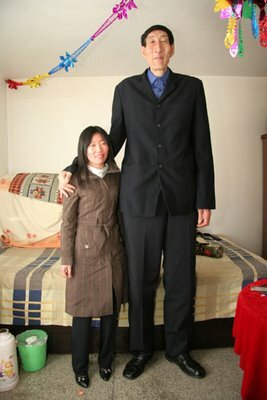
Air China flights from Tokyo to cities near the birthplace of the world’s tallest man Bao Xishun, also known as Xi Shun or “The Mast” (Simplified: 鲍喜顺; Traditional: 鮑喜順) born in 1951, are booked for the next three months in light of a recent discovery by barfoot doctors in the area.

Comissioned by the Chinese Olympic Committee to find undetectable growth substances to give to baketball and high-jump athletes they instead found a blocking agent for the genes known to breed shortness.

Several years too late for me–I stand at 170 cm–the substance causing the stir, Obecalp-A, is made from distilled Miongolian sheep bile. It is expected to recieve governmental approval in Japan even faster than did Tamilflu or Viagra.

Shortly, after Mongolian herdsman Xi Shun made news, the hunt was on for the reason he grew so tall. Bao Xishun claims to have been of normal height until he was 16 when he experienced a growth spurt that resulted in his present height seven years later. “Who would have thought it was the sheep?” said Xi Shun’s new wife. She hopes to pass six feet next year by taking the supplement.

There is already a huge underground market for the extract which is being called “Woolhite” in back alley pharmaceutical shops. Hong Kong authorities have already seized 330 million HK Dollars worth of the drug headed overseas and warn that side effects of poor production can include aimless wandering, sleep disorders, and uncontrolled bleating.

Related posts: Chinalawnblog

Baseball

Asia , Asian Humor , China Olympics , China Photos , China Sports , Chinese Medicine , Humor , In the news , Japan , Just Plain Strange , Personal Notes , Photos , Weird China , april fools joke , 中国

10 comments so far

You must go home again…

“Loneliness is and always has been the central and inevitable experience of every man.”

Thomas Wolfe


I generally solicit views on current events from my students during the first few minutes of a class. It allows them to decompress from submersion in previous courses, informs me about what is current in Chinese student circles and points up, by their unintended omissions, what news as been missed by them via censorship or time constraints. During “current events” this week we reviewed, the “Great Spoon Heist” on campus: It seems that 500 stainless steel spoons had vanished and now the students are forced to eat from utensils with holes drilled in their bellies–which is now kinda tough on the soup lovers I am guessing. And students also told me of the Sakura scandal at Wuhan University–nationally revered for its lush greenery and traditional architecture– in the north of China. Last week a mother and her daughter were run off of campus and vilified on the Internet for taking pictures while dressed in Japanese Kimonos in front of the famed Sakura trees. They were the on the receiving end of local wrath for ignorance regarding the history of the blossoms.

Sakura were first planted by the Imperial Japanese Army occupying the campus during the war years because they were homesick (Thankfully, instead of acts of rape, pillage and plunder they planted flowers and I am guessing did not wear Kimonos to do it…), but those particular Cherry Blossoms died some time later and the Japanese government, so I am told, sent more later as a gift and the remaining 60 or so trees now attract tens of thousands of visitors annually who admire their beauty–and manage to stay a sight more sober in the process than do the Japanese during their viewings in Japan…**

After current events I then told classes about my recent flight into Bangkok, where I was headed for medical treatment, during which time I noticed that the man in the seat next to me reading a Japanese newspaper. Since I am accosted 2-3 times a week for impromptu English practice– and end up feeling more like a parrot than a professor–I thought I’d mediate my 40-year old discomfort with flying and get in some language practice by chatting him up. He surprised me: quickly after he recovered from the shock of a white male on a flight to Thailand from China speaking Japanese he used my earnest attention to tell me of the woes of a Japanese expat living in China. He missed his family, still in Tokyo, had trouble making friends with Chinese nationals (imagine that) and told me how weary he had become of frequent trips to Thailand required by his position. He would never have shared his grief, for sake of losing face or not appearing strong, with a native Japanese, and seemed increasingly happy as he spoke. After his confessional experience he left the plane devoid of the sullen look he had carried on as baggage.

I recognized the look on his face: He was in the midst of haggling with what I have come to call Expats Syndrome. It is depression brought on via cultural disconnection. We all go through it at one time or another and it can steel our resolve or send us headlong into the cultural abyss. It is a a lack of grounding that finds us grasping for tethers–some healthy and some not.

Gestalt Therapist and Holocaust survivor Fritz Perls once observed several children on a beach each react differently to an incoming wave (glee, flight, terrified incapacitation…) and theorized that we are all genetically predisposed to react differently to stressors.  In addition to the excitement and challenge of living abroad, expatriate adventures can be a bit fugitive, solitary and hence stressful regardless of whether you are visiting a far shore to spiritually conquer, study, invade, visit or do business with the natives who reside there.  In recent weeks I have watched expats cope with waking up in a darkening economic environment by engaging in extramarital dalliances with alcohol or women, depression that has functionally paralyzed them or through fleeing homeward toward Europe Canada or America…. Conversely, One British friend in Hong Kong who recently has lost a substantial portion of his business to a partner company’s reorganization took the loss like a true entrepreneur and announced to me: “We have had a bit of a set-back.”  It was not British stoicism or stiff-upper-lip behavior, but rather a declaration of war by an emotionally well outfitted businessman who will certainly outlast any opponent.

Once outside of themselves again and the country they adopted or were sent to explore, many of my friends find themselves more disoriented than ever before. Being disconnected, even for a few months, from the indeterminate and comforting familiarity of the constellations of their youth or most recent native home can render the sights and sounds there unrecognizable. TV shows have gone off the air ( I have been gone so long I am still mourning the loss of Cheers and MASH), schools have closed, businesses have shuttered and friends moved on or passed away. As an aside: during my first trip back to America in three years recently passed by Ft. Ord, where I did military basic training, and saw that a school had replaced the wooden barracks and later learned that there was little left of the the 1/2 billion dollar Mississippi ammunition plant where I had served as XO in the late 70’s–it’s been in mothballs for more than a decade. It is hard to describe the waves of mortality that vibrate their way through every wrinkle and scar you have earned in the years since those times and harder to explain how foreign you can suddenly feel in your own country.

When I reached my hotel room in Thailand I discovered an article in the International Herald Tribune about foreigners who, because of the cost of overseas postings, had been called home early by cost conscious companies, and were wearied and disoriented upon their return even though their assignments had been short. The story was fundamentally a critique of businesses who do not prepare expats for re-entry….

Several years ago I visited Angel Fire New Mexico and the Disabled American Veterans Vietnam Memorial there. It is built on land considered sacred to Indians and the spot where a ceremonial march for Vietnam returnees was held and at its conclusion veterans were initiated into traditional tribal rituals normally reserved for Indian warriors returning from battle. “Native Americans” were wise enough to know that transitioning back to society required care, diligence and ceremonial reintroductions what for others might be seen as mundane. I think the huge number of homeless and jailed veterans is due in large part to our neglect of returnees and a misguided belief that they can safely reintegrate after experiencing months or years of traumatic events. The veterans who took part in that long march still talk of its healing virtues.

As more warriors return from battle, more economic refugees land on Chinese shores and more western sea turtles head back to their nesting grounds there will be problems. And while the Chinese use an idiom that admonishes us against the danger of having a foot in two boats, I argue that we must stay grounded in our home culture via news, music, movies, art, conversation, books, or blogs while slowly immersing ourselves in a new one. We all cannot be as strong as my friend in Hong Kong and while we well may be hard-wired as to how we’ll respond to stress, but we can mediate the magnitude of our reactions by keeping tethered somehow to home. I just came out of a numb sleep brought on by being ill and having little to grasp onto for comfort, but I am a very lucky veteran traveler who has amazing, loving, keen observers as friends. They threw a line into the abyss. I wish this kind of good fortune on others.

We must go home again, if only virtually, from time to time…

More in a part II

**related Cherry Blossom stories: CHINA SMACK (with hilarious comments by readers below the story) and the

East South North West Blog

Uncategorized

8 comments so far

China PR 2.0 Optimization Workshop

Moving From Traditional to Social Media:
Easy Ways to Integrate SEO, Social
Networks & PR 2.0 Strategies  for Success
With Lonnie B Hodge,  Des Walsh, Brian Solis, Alvin Chiang, Omniture, Xiaonei and others

April 8th 2009 from 9 AM-5 PM

Bi-Lingual: Chinese and English

MARCH SESSION SOLD OUT

All dates and Times=China (EST +12)

For full details and sign up info go to: PR 2.0

A hands-on workshop to be held in Guangzhou, China and Broadcast Worldwide. It will teach you what you need to know to begin conversations with customers in online marketplace. Hit the ground running with several of the web’s best-known social media practitioners. Special technical skills will not be needed to to learn how adopt and employ social media: blogging, micro-blogging, SEO, social media news releases and social networks. You will begin to master cutting-edge tools essential to brand
and reputation enhancement especially needed in tough
nancial times.  Joining this hand-on- your-shoulder class, led by two world-class coaches, who practice what they preach, will guarantee that you return to your company with real-world skills that will improve your bottom line through market engagement.

Professor Lonnie Hodge and Executive Coach Des Walsh will give you an international perspective no other global teachers can: An authentic, international view learned by experience and practice. Economies are inter-connected and authentic cross-cultural dialogues with existing and potential customers will give you a competitive advantage. Leaders Walsh and Hodge will teach you to build alliances in foreign markets.

Special technical skills are not needed as your learn how to engage customers through social media, while understanding the underlying terms, tools and practical applications for learning to speak to, not at, your customer. You will develop, in class, usable social media PR releases, use social media interfaces, write SEO best practices compliant HTML (if you can use MS Word you can do this!), and optimize visual and written content for releases, ads and websites to increase your bottom line.

Who Should Attend?
• PR And Advertising Staff
• SEO Professionals
• CSR directors
• NGO/NPO leaders
• HR Personnel
• Senior Executives
• Online Marketers
• IT Supervisors and Programmers
• YOU

Listed below are some of the topics that are to be covered at this one-day seminar:
• Social Media: The most powerful global sites where customers and brands interact: Twitter, Xiaonei, Facebook, MySpace, which platforms to engage and who to follow into those spaces.
• Free and inexpensive tools, including Alpha and Beta releases, foroptimizing sites and news releases to reach a larger audience: Powerful services like Pichengine, Involver, Seesmic that are not yet in general distribution…
• Social ROI: Groundbreaking Social Web Measurement tools that teach you the who, what, where, how, and why of visits
• Success and the Art of Listening: Moving from disruption strategies to engagement while overcoming the fear of transparency
• The Future of Blogs, Video Sharing and Social Networks

You’ll receive a free newsroom on Pitchengine.com and a month’s worth of unlimited and archived online social media press releases. You will,before you go return home, have a release indexed on the world wide web–worth the price of a seat. web–worth the price of a seat.Before the day is over you will create a real press release that will appear in major search engine news before the day ends.

Shel Israel, author of “Naked Conversations”, calls on businesses to respect social media spaces; Social Media Pundit Seth Godin labels that approach, Permission Marketing and Hubspot views it as Inbound Marketing. We refer to it simply as Conversational Marketing and it is essential in a world where the power of marketing now relies on two-way communications.

Benets
Together we will:
• Easily create online news releases with the use of free and inexpensive tools to broaden your internet reach
• Demystify techno-jargon with a Do It Yourself kit for social media marketing and increased search engine rankings. You will easily understand how to use keyword selection, inbound links, anchor text, universal search, photo tags, url selection
• Learn to internationalize messages with intercultural communication strategies in advertising and PR copy
• Master the use of digital conversation tools: Social Network Platforms, Viral Videos, Social Bookmarking Sites, Corporate Blogs, and Professional Networks
• Actionable Analytics: Discover how to use measurement tools that will illustrate the effectiveness of your web marketing and PR efforts and guide future advertising and marketing decisions
• Develop an understanding of how to listen to customers and their feedback and to articulate brand-building messages that establish trust and con
dence…

Workshop Leaders

Brian Solis, author of Social Media Manifesto, the Principal of FutureWorks, an award-winning PR and New Media agency in Silicon Valley.

Alvin Chiang, former VP of NetEase and Alibaba Group , Currently CMO of Oak Pacific Interactive Group that runs the largest Social Network in China, Xiaone.com

Des Walsh, the author LinkedIn for Recruiting and Seven Step Business Blog, business coach and social media strategist.

David Li, application developer of the most popular Facebook applications such as Growing Gifts and Hatching Eggs, has been involved in social media for more than 10 years and has built several social networks sites.

Omniture, a representative from Omniture–a world leading search management, online digital optimization, web analytics provider.

Asia , China Business , In the news , Intercultural Issues , alibaba.com , 中国

One response so far

The only man in China who likes Australia…

…the movie.

And I am glad I saw it.

australia

I had some time in Beijing, between the blizzard of social connects and meetings that are part of any trip I take outside of Guangzhou, to see the movie Australia. I don’t make it up north very much anymore so I  try to maximize my time while still managing to squeeze in a little enjoyment: seeing a movie, bravely foolishly curiously trying some new local dish, making new friends, enjoying a movie or cherishing a few moments with old acquaintances. I did all of that over two snow scattered days in the capital city.

The only movie showing at a time that would fit into my schedule was the aforementioned blunder from down under. Australia is a cinematic muddle of  magic, mystery, murder, military, melodrama megalomania, and memoirs from a bigot ridden outback….It is so bad that it is a sure bet we will see it again on Hong Kong’s ATV or CCTV here in mainland China.

But, I am glad I saw it.

The movie wandered the bush in search of a theme and stumbled over romance, history, allegory, and object lesson before falling down on a soft core adult tenor via a buffed up Wolverine bathing out of a bucket (and no, the consonance decided on itself…) in front of a barren, befuddled and buffoonish Nicole Kidman.

But I am glad I saw it.

All kidding aside, and man is that a Crocodile Dundelean feat, I learned a lot:

The Japanese rained down more bombs on the port at Darwin than it did two months earlier at Pearl Harbor in the 40’s. And they attacked another 63 times over the next two years to bring Australia as close as it has ever been to war on its own soil. That one reviewer of the film, and one Wiki entry, calls the assaults on Darwin “Australia’s Pearl Harbor” is exactly why I am glad I watched the movie….

A few days ago, if you will permit me a rare digression, I read a viral email sent to me by a “conservative” friend ( conservative is a euphemism, but as close as I can come without risking war on my own turf) who lives in America (the part with 50 states)… He and the email author somehow did not know that Australia had elected a new Prime Minister nor that the alleged PM had not boldly declared that Muslims should denounce their heretical ways and swim off to calmer spiritual waters–while hopefully meeting and greeting several sharks along the way–in an effort to ethnically cleanse Australia….The email was likely designed by an American and meant to give credence to some nationalist notions that U.S. borders should be closed, job stealing wet-backs flung back into the Rio Grande in order that we might realize a new prosperity: thousands of t-shirt assembly-line jobs, radish picking tasks and domestic helper slots that will vault us out of our recession far better than any stimulus package.

When did we become an ethnocentric melting pot? (That is only an oxymoron if you don’t believe that the National and American Leagues can collide at the end of the year and actually play a “World” Series in baseball.) And just so you know, I am guilty too of narrow thinking despite three decades abroad: You mean WWII was not just the U.S. against the forces of evil? The Allies (a close knit group of American G.I.s) didn’t single-handedly saved the world from the dreadful grammar of the Germans and the limited syllabary and endless bowing of the Japanese? I confess to never knowing before this movie that the country, who has battled and died alongside America in every major war and conflict in the last 70 years, suffered the loss of so many lives in Darwin.

Oh, and just for the record I learned from my good friend Des that “Waltzing Matilda” is no more the National Anthem of Australia anymore than “Danny Boy” is the musical representative of Ireland…;-)

We all need a culural wake up once in a while. I thank the the director of Australia–wherever he is in hiding–for mine…

Uncategorized

7 comments so far

Twenty-Five Things….

Since I have been tagged numerous times on Facebook with this Meme I thought I would do a serious version in answer-though don’t expect a totally straight face. The beauty of a meme like this is its ability to tilt you away from the events of the day and give you a reason to take a meta-view, as unobstructed as memory will allow, of paths in shadows and ahead, in the gathering light.

olgacornucopia400w

25 Things about me….

  1. I see myself as a combination of two Jungian Archetypes: The Lover and the Magician. The lover in me is the guiding force in my poetry: dialectical and unquenchable desire, immediate sorrow and regret, and a notebook full of “portable kisses.” The Magician in me looks for ways to explain, guide and tempt people into learning and to give voice through art to the good in Kings, Magicians, Warriors and Lovers so people might cherish both calloused hands and  unprotected hearts; to seek the laws that make me, the lover, so sensitive that there are days I feel like lying down because I am dizzied by an earth I can feel rotating on its axis.
  2. I have been physically tortured with the consent of friends–ones  I belayed to safety, but who left me un-anchored and unprotected.  But, despite that my world view still pardons the days for ending too soon and pities the men who never turned to see their shadows disappear; hence, I am quicker to forgive a murdering stranger than a disloyal friend.
  3. I should have left her sooner.
  4. I should have married her when I had the chance.
  5. I love the outdoors. I never want to draw a bowstring or pull a trigger ever again but I want to always see bright stars, even in the dark pools of evening waters. I secretly want an hermitage on a mountain, but with plenty of guest rooms for the people I love.
  6. I almost died of a ruptured gall bladder so I long ago said my goodbyes. I have had a perfect daydream (and occasional nightmare) of a life: archer, writer, actor, father, soldier, businessman, teacher, healer….My life is a billfold of foreign currency spent wisely as well as in proportion to my foolishness…
  7. I never opened a book during school. I couldn’t afford one.
  8. I talk too much, I praise too little, and I am as forgetful as the tide: sometimes leaving without thanks…
  9. I could live on fried chicken, boiled shrimp and garlic-buttered broccoli in perpetuity.
  10. I wish the kisses given by adoring students to  philandering colleagues, priests and teachers in my life would re-appear and show themselves like cancer.
  11. I miss my mother.
  12. I have lost or broken every watch I have ever owned: It is a metaphor for my disdain for time.
  13. I am spiritual, but have grown weary of the religious calisthenics of the west and am too attached to beauty to imagine a bowl to be broken in advance of its demise to be a devotee of eastern thought….
  14. I have a secret crush on Yang, Li Ping that is now not a secret anymore.
  15. I believe that vengeance is in reality an act of regret.
  16. I forget #15 to be a truth too often and fail to forgive myself in time enough to spare an ambush.
  17. I teach in the same voice that speaks from my poetry. It is fearlessly loud enough to carry past 10,000 ears, but I am shy and at parties I end up making make sounds resembling uncomfortable wings below tattered eaves.
  18. I think I have was passed some secret gay fashion gene meant for critique, but not personal styling.
  19. I cry every time I attend the theater because it is where I wish I could have spent more of my adult life.
  20. I believe that too many policeman and statesman are costumed, gutless criminals.
  21. I once believed that if I could write just one poem, like a Mark Doty or a Robert Bly, that could empty you of sorrow or turn into itself into a shutter that could bang life through an abandoned memory that I could die happy. Now that I am older I have amended that to two, or three or….
  22. I think most artists, like myself, are afraid of going mad; great artists revel in their lunacy.
  23. I believe we should restore the draft, but only to put teens to work in charities not war zones. Station them with NGOs or in citizen media training, as bloggers/micro-bloggers while living in homeless shelters or prisons.
  24. I blame religion and government for imprisoning, with laws and rituals, the spiritual gifts that built the great cathedrals and carved gentle, giant Buddhas out of rock.
Uncategorized

4 comments so far

Ghost Whisperer

When Wordpress suffered a security exploit last year several of my blogs were affected. Thanks to the Internet Wayback Machine I recovered many lost ones. This is one I am glad to have found again.

death catcher

I learned today that my sister passed away. I learned over the Internet that she died in November of last year. She was much older than me and never in great health, so I had wrongfully assumed she had “crossed over” years ago. Tonight in the still heat of a stifling Guangzhou I smelled the sour scent of some hard traveled memories and heard her whisper to me….

No, we were not close. Marriage came early for her, when I was 5, and before I was developmentally mature enough to crave or mourn losses. My military family was turning corners in or out of countries every three years or so and making the word “home” an abstraction. My sister was never in our family pictures. I saw her only a few times through the years and her face in my mind’s eye is blurred. I can remember her often speaking of pain and that remains palpable.

Until tonight I had almost forgotten I had a sister. She had been adopted by my unmarried mother at birth. She saw herself later in life as a stubborn vine that connected all of us to my mother’s alcoholic ex-husband and his mistress: She was the offspring of an affair, so her past was kept secret by my simple and well-meaning parents until she was a teenager. My mother and father, emotionally unsophisticated and afraid, asked a Catholic priest to substitute for them and tell her that she was adopted. It did not go well.

I have been watching DVDs this week “expat style.” We often buy two or three seasons of a show at a time, ones we cannot watch on regular TV and then air them from beginning to end in only a few days. It is a way to keep current with our abandoned culture and remain bonded to the lexicon, fashions and familiar emotions of our birth home. This week I have been storming through two seasons of Ghost Whisperer. And I have come to love the show for its generally positive outcomes, its promotion of health through acceptance and forgiveness and its desensitization of our collective fear of the unknown.* The protagonist of the show, who can see troubled spirits, helps earthbound souls unpack the heavy emotional baggage that holds them here. She helps them release after-longing and pain from the past so they can peacefully migrate into their future. It is not a story about religion, or eschatology (life after death), but about how to live well and without regret.

My mother developed Alzheimer’s disease and never was able to finally confront the trauma of being abandoned by her impoverished mother during the Great Depression. Too, she rarely spoke about the man who had deepened her emotional wounds later in life. She did so to protect herself and to maintain some illusion of normalcy for my sister and me. There was no malice in her deception, though my sister never forgave her or my father and never found emotional nourishment that would sate the pain. Where my mother insulated herself with delusions ( and maybe her disease), my sister did so with anger and distrust. After my mother died, I read in another Internet article that my sister had embarked on a public journey to discover more about her origins. I hope to learn one day that she was successful.

I wonder if other expats learn about their vacated lives past and present as I do? I view time compressed, via boxed sets of information that arrive in emails, letters, DVD’s and Internet entries. It was almost five years ago to the day that I leaned my sister’s husband had died an improbable death: an avid outdoorsman, he had contracted Bubonic plague from an insect bite while hunting. He was the first man in America known to have succumbed to the disease in decades. He was the most gifted craftsman I have ever known, but held back from his dream of being a woodcarver and gunsmith by the needy gravity of my sister’s suffering. So, I grieved my loss and his because his short fame was only in the peculiarity of his demise. We wandering expats may seem not to care about what happens to you, but we do. I do. And I, like others, frequent the few paths we can find along time’s rivers looking for signs of you. But can be a lonely and overwhelming journey when information flows so fast from so far away.

I laugh, mourn, celebrate and educate in absentia. Memory also presents to me as a frightened bird that requires patience to keep it nearby long enough that I can study, appreciate and accept both its beauty and its flaws.

I pray that both my sister and my mother are finally at peace. I long ago forgave them for simply being human. I hope they forgave this homeless child for the manifestations of his confusion .

I am the earthbound spirit now: I am on the banks of the river, coaxing the birds and vigilantly listening for whispers….

Uncategorized

4 comments so far

Blue Feather Tweeters

flip the bird

Forget all the incestuous top Tweeter lists, the rankings of the most re-tweeted, the scores for the most influential, the “find a MLM spammer to add to your follower cool twitter application” lists and the “Twitterati” glamour gurus vying for rights to the title of most vapid… So, I thought “How about a list of the top 20-30 nicest people to meet and tweet on Twitter? ” Here are my first picks for Blue Feather Friends–who actually talk to you….

I follow a lot of folks because I am a student of anything and everything on the net. I have used hundreds of Facebook and Twitter Applications, joined  (and un-joined) groups with great names like “Ban the Racist Bicycle Bells,” My life is a musical” and I’ve been bought and sold hundreds of my friends in and out of slavery and then raced them in cars that don’t move. I have crashed my site dozens of times with new Wordpress plug-ins and I have tried virtually  (and to the lament of my twitter stream) every mobile and fixed Twitter client around. And aside from the auto-generated DM’s that say “Thanks for the follow <<insert first name here>>”  via folks in a race to catch Obama in the followers count, and that big breasted bot with 450 different profiles, I have become grateful for the many people who have enriched my life and replaced my blogging, RSS reading and shower time (phew) with interesting stories that I will no doubt re-tweet one day to my grandchildren.

Following are a few of the nicest people you’ll ever tweet. I don’t know how many followers they have, whether they won shorties or longies or what their Hub score is… And this is not a list of my favorite charities, business folks, incredible journalists or people you need to suck up to to get them to add you (Brian Solis, Mashable, Winer…)…I will do those lists one day as well…

These are just  people who aren’t so impotent (sp?) they only follow and/or talk to themselves…

Maybe in a day or two I will post my top financially useless, but great smile-making Twitter applications and add a few more suggestions for people to chirp with…. Feel free to add your own BCTs in the comments section…..

  • http://twitter.com/shelisrael is from California. He is writing a book on Twitterville and is a bit of a celebrity, but his bio’ is right: he is a nice guy who actually talks TO, not at, you. And he is his own virtual assistant ;-)
  • http://twitter.com/danharris He is a lawyer but don’t let that put you off. This is the most tireless guy on the net. He actually reads and comments on dozens of blogs, runs the best law blawg on the planet ( http://chinalawblog.com ) and still has time to go to his family’s sporting events in Washington, root for the Cubs and then Tweet about it! Caution: Do not try to sneak a knuckle ball by him–he will hit it out of the park.
  • http://twitter.com/gyspsydust A world-class Chinese medicine expert from Illinois and one of the nicest people on the net. We met on Facebook when she suggested pointed me toward W.H.O research on a medicine that cured a recurrence of malaria that had hit a visiting guest–and it cost us less than a buck.
  • http://twitter.com/sdweathers A growing celeb’ on the small screen here in China. He posts great culturally entertaining pics, fun and informative links and actually takes the time to answer his tweets.
  • http://twitter.com/deswalsh An Aussie coach and consultant who has forgotten more about social media, blogging than I will ever know. He and his “girlfriend” (sorry, inside joke) artist  http://twitter.com/suziecheel  are an endangered species: kindness, wisdom and humility abound…
  • http://twitter.com/taweili Did you ever get a growing gift on Facebook? This is one of the team that built that application. He is a cross-cultural commentator and shouts out some very sensible answers about life and tech from farther inside the matrix than I have ever traveled….
  • http://twitter.com/grahamdbrown from London he runs one of the coolest and most purposeful blogs around and remains as authentic and likable a personality as you can find in the Twittersphere….
  • http://twitter.com/davidfeng when you think David Feng you think War and Peace, Ulysses, Everything You Wanted to Know About Beijing Subways Even if You Didn’t Think to Ask…The only guy on Twitter who HAS to have a David Feng Lite stream…I met this Swiss master at the first Beijing Tweet-up–there were three people and 10 electronic devices present….
  • http://twitter.com/JeffreyJDavis from Charlotte. Personable, but not afraid to call out the thought leaders. His profile says it best: “Innovator, Leader, Strategist, Executor, Mentor, Smartass, Kiteboarder, Dad, Husband”
  • http://twitter.com/thomascrampton An American gone Hongkese whose blog features impromptu camera phone interviews with the likes of Oliver Stone….He is an old-school journalist (small stuff like the NYT and IHT) who, despite his celebrity, is engaging social media with the heart and curiosity of a child combined with the shrewd thoroughness of a trained  reporter–No small feat, that…
  • http://twitter.com/winserzhao A die-hard social media fan with his own travel company. The ONLY one of the 8,000 Tweeple I reached out to for help  that answered the call to rescue a newlywed–stranded in China– who had all his money and documents stolen just after his wedding.
  • http://twitter.com/johningz I think Foreigner did a song about him once….He lives in GZ where I do…The whole city keeps getting younger around us….He can Tweet and eat Pizza at the same time…and does….most days….every day….
  • http://twitter.com/casperodj A Dutchman studying in Britain now. He made history by beating the news wires with tweets from the earthquake zone in Sichuan China…A former Olympic caliber archer, he made watching the shooting events from Beijing a blast by live-tweeting the events…
  • http://twitter.com/Meryl333 Delightful, spiritual ex-lawyer and biz strategist from Chicago now in San Francisco….She sometimes beats me at online Scrabble….

This is by no means an exhaustive personal list and it augments posts where I have mentioned others…And I do mean to add more later…

I am http://twitter.com/lonniehodge I am a Twitterholic….

Uncategorized

10 comments so far

Hostage Situations: Culture, Charity, and Cures

A few years ago a Washington DC taxi driver, Timor Sekander, a survivor of the Afghan war  with Russia, saved my emotional life by sharing the pain of his losses–a father, and two brothers–with me,  a stranger, looking for answers en-route to the Vietnam Memorial. He turned off his meter and spent two mercurial days introducing me to dozens of grateful refugees who mediated their memories and healed their common wounds by helping each other survive everyday challenges through trade, fellowship and commerce in a country not yet sure how to appreciate their talents or accept their presence.

On Twitter yesterday I engaged in a conversation with a man in Mississippi who had publicly decried Obama’s recent executive order that will close Guantanamo Bay (Camp Delta) within a year while granting legal rights to those incarcerated like the Chinese Uyghur Muslims held there for years without formal charges or trial.  In 17 current cases, detainees were found innocent of any wrong doing and worse yet, some Uyghur prisoners arrived at Gitmo months after being kidnapped near Afghanistan by U.S. supported vigilantes who were paid bounties to round up suspected terrorists. I replied by applauding the executive order and let him know that I had read on, past the section granting constitutional rights, to the section with a clearly worded directive ordering trials and punishment for those the evidence suggests are truly terrorists.

This is not, and was not, a political argument for me.

gitmo-prisoners

My new “follower” on Twitter used the heavily charged word “terrorist” during out talk to describe the detainees still held at Guantanamo and said they did not deserve constitutional protection. He went on to say that the terrorists were being well cared for and nothing at Gitmo could be “construed as torture.” I contend (ed) that being separated from your family and locked in even in the cleanest of cages for four to eight years with recreational water-boarding occasionally on your schedule could hardly be construed as a tax payer funded vacation in Cuba….Terrorist is a word we have been conditioned to associate almost exclusively with the Arab world, so it is easy to imagine that where there is religious smoke  there is terrorist fire; conversely to entertain “torture” as a part of the American lexicon is to appear anti-patriotic,or treasonous at best….

Last week I was talking to Diaster Relief Shelters founder Roland Catellier about the trials inherent in fund-raising for homes and dormitories in Sichuan where millions are still without adequate protection. Those Chinese now living in temporary shelters may well be sharing cooking and toilet facilities with dozens of other families. It is a disaster-induced prison with many innocents serving indeterminate sentences for the crime of poverty.

Collecting funds to help survivors of disaster or trauma is the greatest challenge of any charity in China.  Many people view the Middle Kingdom and all its inhabitants as economic terrorists who are part of an industrial entity that has robbed them of jobs or shut the doors on their neighbor’s family business. And the huge and faceless numbers of those dead in China keep us and any Chinese who could help from looking too closely at the anguish partly made of indifference, or helplessness or fear of falling into some mournful abyss. It is hard for many to care amidst soaring unemployment that has now washed ashore in China and the beleaguered in Sichuan are hard to segregate from the 900 million others in poverty trying to live on less than $1.50 a day.

Sichuan Destruction

I feel ill today and spent the day, when not sleeping, in video and written excursions away from fever and body ache. There is no fun in dwelling in physical or societal misery and I spend more time in concocting solutions than I do recounting trials. So, today I read and  listened to teachers and practictioners of comfort and compassion. My favorite diversion today was a visit with the “happiest man in the world,” Matthieu Ricard, a Buddhist monk, author and photographer via his lecture on TED.Even the man whose extraordinary bliss has been scientifically documeted spoke about the fleet-footed nature of feelings. He acutely feels anguish and sorrow, but can skew his thoughts and actions toward solutions and reconciliation. His spiritual leader recently said that while he often diagreed with George Bush, but he loved him–and I believe him.

I know, as one who lives daily with the extreme and varying degrees of pain associated with an autoimmune disease, that it is through compassion or sharing that I can dissolve associated anger, irritations or suffering. Teaching and writing are my active meditations, my ways of showing compassion: In classes where I really give of myself I often vanquish colds, unlock painfully secured limbs or transform a mood from depression and despair into extreme contentment. And the receipt of good teaching and compassionate words that issue from sage friends like Des Walsh, Zach my monastic guide and Debra Xiangjun Hayes can have the same impact.

Ricard talked to the unseen dual nature of things like the depth of an ocean below a roiling, temperamental wave: There is more than meets the eye in all things. It brought me to thinking about how charity and compassion and even health are often hostages of  our narrow fields of vision–those accepted by us, even if foisted upon us, without compassionate investigation on our part.

The first thing a police negotiator does in a hostage crisis is to begin calling the victim in peril by their true name so that the perpetrator can hear and see that he is a life threat to a vital, breathing person, a sentient being and not just an object for ransom, or a means to an end. There is always hope that you can resonate with the good, the ocean below, in even the most violent of waters.

charity

Michael Berg at the Kaballah Center says in a recent article that we must make conscious decisions that bring us to a place where we are willing to experience the pain of taking on the burdens of others. I think before we can devote ourselves to the Sisyphus-like toil of charity in a place like Sichuan, as has Roland, we must acknowledge some emotional or human connection. we need to see the faces of those in distress, we need to hear their stories and politics will be forced to embrace new priorities. I will settle for even a few more of us taking time to divest ourselves of preconceptions so that we feel an imperative to engage, not war with, people making decisons, not to interfere with our well-being but to survive themselves just one more day. It s then we can follow Berg and feel, to paraphrase Camus, that to help someone you have been taught to revile or to offer money time or comfort to aid someone who may only have minutes to live is a struggle, but one toward the heights of selflessness and it is, by itself, enough to fill any man’s heart.

More in Part II

Addendum: Four good places to begin to appreciate China’s people: Blog of Dreams, Tom Carter, The Library Project, Derrick Chang’s Mask of China

Uncategorized

5 comments so far

Whose Enemies Are They? Part II

I recently spent three days and two night with 85 native Chinese English Professors and school administrators. It was a pleasure trip that Expats in China who suffer from conversational anemia would have loved. This journey was rich in cultural and intellectual nutrients. Since most of the scholars there were educated in both China and the west, it made for great interactive subtleties, and an occasional journey into densely forested woods of dark humor…

At one point during our travels I was verbally recalling a story about four Chinese exchange students who, after 9 months of absence from their classes were reported missing and subsequently found dead in their Australian flat.  Without hesitation one professor wryly queried, “were they allowed to graduate?”

mao_leading_peasants

The professor who spoke is a bit of living history: his first job paid about 20RMB per day ($.15 cents then. By contrast an enlisted man in the US Army made $3.00 then) and his driving ambition was to save enough to be able to buy a bicycle. Bikes sold for 100 RMB at the time, but only if you had a voucher permitting you to to own one. And even with a voucher there was a bribe that often had to be paid locally that tacked an extra 100 RMB on to the final price. He was one of many intellectuals driven to the countryside during the cultural revolution in an attempt to teach them humility and put those like him more in touch with the proleteriat–the working class. He knows, as shown by his retort, that China has sadly followed the west into areas of industrialized education and that those with money or power need not study nor even attend class to attain a sheepskin in China or America.

Another professor then shared with me a game started in the 80’s in Wuhan (one of four directly controlled municipalities), but is reflective of the time in which he grew up, a time when “authority figures—teachers, landlords, monks and nuns, bosses, intellectuals, doctors, Party leaders—were ‘struggled against’ by gangs of teenage revolutionaries called Red Guards.” The card game, called Beat the Landlord–Dou Di Zhu– (literally fight the landlord) is now wildly popular on the Internet here and has some 20 million players on “QQ” (the most popular of messenger services here in China), allows two “bandits” to gang up on the “landlord” in order to allow one of them to divest himself of all cards and win. The social ramifications are now gone and the meaning all but lost on one of the younger teachers who was listening to music on his Mp4s and feigning interest as would American youth over talk of days of black and white TV or civil rights marches. He attained his diploma the old fashioned way: he earned it albeit with a bit less sacrifice. But, having heard such stories many times before he lacked interest in the topic.

cultural revolution

Also at the gathering were members of a few of the reviled groups labeled as such during the Cultural Revolution: The “Nine Black Categories”: Landlords, rich farmers, anti-revolutionaries, bad influences (the catch-all available in any culture), right-wingers, traitors, spies, capitalist roaders and lastly, intellectuals—scholars have been last, or next to last in Chinese caste hierarchies since the Yuan dynasty where they were only slightly better regarded (ninth) in that caste order where beggars were tenth. Present too were past members of the Hong Wei Bing (Red Guard) the more violent of whom persecuted scholars, committed acts of violence against landlords and others (even Deng Xio Ping), famous temples, shrines, and other heritage sites (4,922 out of 6,843 were destroyed). Now all of us, including two Gweilo (”ghost men”) were sharing rice at the same table…

On day two, one of the four “Waijiao” (literally outside teacher, but used to denote any foreign lecturer), having not heard the instructions (in Chinese)  early on in our adventure, boarded the wrong bus; hence, we were one person short in our count overall. Speaking in Chinese some of the teachers near me began grousing that it was, of course, a foreigner holding up what was to be called later a “long march” though an area cave. In fact what had happened was that a couple of other native “bad influences” were late due to having gone one Baijiu ( legal Chinese moonshine) over the line the night before. The Chinese teachers, accustomed, but resentful of the leeway given to foreign teachers, were unified in their belief that an outsider was the cause for delay.

I spent a lot of my trip directly and obliquely querying teachers and staff regarding their attitudes toward visiting teachers all of whom are accorded the title of “Foreign Expert” by the provincial education office even when only qualified to teach English by virtue of their country or skin color of birth–credentialed and talented Waijiao are hard to come by here.

Later when at a table with graduates of top schools domestically and abroad it came as no surprise to me that when introducing members of the group seated together a young lecturer referred only to his colleagues as “professors” and ignored giving titles to the two foreigners present; so, later that night during a karaoke break I did not even flinch when another junior faculty member angrily asked friends in Chinese, “Who invited the Waijiao?” They are weary of the unacculturated backpackers who pass though schools with far more in the way of critical opinions than useful skill sets to share….

After twelve years of post secondary education and three decades in the classroom, mostly overseas, I am secure in my scholarship, attempts at cultural sensitivity and pedagogical abilities. And while hurt and, yes miffed too, I try to understand the frustrations of the younger, poorly paid intelligentsia who react more negatively with more vigor as the west fails to recognize the monumental changes in China of the past 15  or so years thus putting these savvy scholars on the same cultural bus as some of their revolutionary predecessors or corrupt present day business and political leaders. The world media has most of the west still reveling in anything draconian while failing to give credence or applause to any positive steps toward becoming responsible global leaders and resentment runs high here.

The west is engaged in a newly branded western game of  Beat the Landlord as China begins to dominate certain world economic sectors. And our failure to engage them and recognize and encourage  accomplishments, a punishment model approach to change, is fueling a long held distrust of those on the far side of the wall. One academic told me that it will take time for the people of China to manifest a viable bill of rights, “perhaps more time” he told me, “than it has taken your country to deconstruct yours into a bill of rights and wrongs.”

It is a dangerous, knee-jerk nationalism that we foster in both east and west when we don’t acknowledge that most Chinese people still long, and are willing to struggle for, the present day equivalent of a revolutionary’s bicycle…

More in Part III

Uncategorized

One response so far

Lucky Pants!

It is time for my annual Lucky Pants Post! I am putting it up early so you beat the rush to the Great Wallmart to bag your boxers. A couple of years ago Ar Yang took me shopping in Nanning for these to ensure my good luck and I still have red stains on my cheeks (embarrassment, not….)….

LUCKY PANTS

Ben Ming Nian, or Lucky Zodiac Undies, are a must for anyone who is celebrating their birth year as a Bull in China. Happy Niu (cow) year!!

If you are not a Bull you don’t NEED any lucky pants, but it couldn’t hurt.

I was in a rural area this weekend and learned of a few more superstitions: You never break anything at a potential parent-in-law’s first meet-up because it signals a possible break up in the future and they won’t serve you chicken wings because it might instill a sense of flight in the bridegroom.

And about LUCKY PANTS!: You are supposed to have a healthy supply of these every twelve years and wear them EVERY DAY (pray that they are color fast fabrics: see above) and they will reportedly protect you from ill fortune.

Now if you look closely at the picture above you will see that there is a Chinese symbol on them. It is actually “GOOD LUCK” written upside down. Upside down it means: ” GOOD LUCK is coming” (I heard that)!!

I came across a couple of great stories while researching this post:
One mistranslation for a popular Christmas movie changed “You will get a pink slip for Christmas” (Guess the movie? Know the album?) to “You will get red underpants from Santa Claus” Thanks to the translator’s error, viewers happily envision the hero in a pair of red underpants, not realizing he was fired for Christmas.

And in India a man allegedly prevented a train disaster by waving his red underpants in the air. (Don’t visualize!): Nimai Das was relieving himself near the tracks when he noticed that a part of the track was missing. Shortly afterward, he saw an approaching train.

According to The Indian News Source Sify, he stripped and began waving his red underpants frantically to stop the train. He caught the driver’s attention (imagine that) and the train stopped just a few meters ahead of the broken line.

Maybe he was born in the year of the Bull…??  HAPPY?

After this was published the first time many people pointed out to me that I was #1 in Google for months as Professor Lucky Pants. That tag best belongs to a couple of my old poetry professors most certainly born in the year of the dog  ;-)

Asian Humor , China Business , China Humor , Confucius Slept Here , Humor , Intercultural Issues , Just Plain Strange , Personal Notes

10 comments so far

AN AMERICAN POET IN CHINA

My first mentor during my MFA training in poetry Mark Doty had won coveted several awards before I met him and he went on to claim every major award, save the Pulitzer, in and out of the U.S.: The National Poetry Series, Britain’s T.S. Elliot Prize (the only American to ever win and he is nominated again this year), The L.A. Book Critics Circle, National Endowment for the Arts Fellowships, A Guggenheim Fellowship and now the National Book award. He is America’s best Lyric Poet.

I started going through work, finished and unfinished, after learning of his selection for the National Book Award. His award awakened in me my deep respect and admiration for all he taught me and has prompted me to invite my fickle muse to visit with hopes she’ll have me back. It was during my search that I discovered this post…

Here it is  recovered again from the past with a still unfinished poem added at the bottom….It is far from complete, but you’ll understand why after reading it…

AN AMERICAN POET IN CHINA

I was blog-roll diving last year over at China Rises and saw a listing for An American Poet in China. Now that peaked my interest! I opened the site in another tab, and then another and once more just to be sure: I was looking at my own site.

I am not sure what prompted Tim to label the link as such, but I am grateful. Of all the salutations or titles that I have proudly worn, or have had foisted on me, poet and teacher are the two I most cherish.

Google did not fail me as I went on a hunt for an American Poet in China: I found Tony Barnstone, once an English teacher in China and now Professor of English at Whittier College (Nixon’s Alma Mater) His books include Sad Jazz: Sonnets; Impure: Poems by Tony Barnstone; The Anchor Book of Chinese Poetry; Out of the Howling Storm: The New Chinese Poetry; Laughing Lost in the Mountains: Poems of Wang Wei; The Art of Writing: Teachings of the Chinese Masters; and the textbooks Literatures of Asia, Africa and Latin America, Literatures of Asia, and Literatures of the Middle East. Born in Middletown, Connecticut, and raised in Bloomington, Indiana, Barnstone lived for years in Greece, Spain, Kenya and China before taking his Masters in English and Creative Writing and Ph.D. in English Literature at U.C. Berkeley. You can find his work here: Barnstone

You see? There is life after ESL teaching.

And I came across an old acquaintance Li-Young Lee: He was born in 1957 in Jakarta, Indonesia, of Chinese parents. His father, who was a personal physician to Mao Zedong (His book, banned in China, is The Private Life of Mao Zedong) while in China, after being released from imprisonment in a leper colony following Mao’s death he relocated his family to Indonesia, where he helped found Gamaliel University. In 1959 the Lee family fled the country to escape anti-Chinese sentiment and after a five-year trek through Hong Kong, Macau, and Japan, they settled in the United States in 1964.

Li is the author of Book of My Nights (BOA Editions, 2001); The City in Which I Love You (1991), which was the 1990 Lamont Poetry Selection; and Rose (1986), which won the Delmore Schwartz Memorial Poetry Award; as well as a memoir entitled The Winged Seed: A Remembrance (Simon and Schuster, 1995), which received an American Book Award from the Before Columbus Foundation. His other honors include a Lannan Literary Award, a Whiting Writer’s Award, grants from the Illinois Arts Council, the Commonwealth of Pennsylvania, the Pennsylvania Council on the Arts, and the National Endowment for the Arts, and a Guggenheim Foundation fellowship. He lives in Chicago, Illinois, with his wife, Donna, and their two sons.

He is one of the most passionate writers in America. Many of my phone calls and visits with Li-Young Lee left me believing that I was indeed talking to someone who was hard-wired to an enviable spiritual reality that he successfully struggled to make sense of in his work. I once asked fellow poets at Vermont College to describe him and every single poet, man or woman, called him “beautiful”. A few of his poems are here: LEE

And to my great surprise I found my name. In March of last year the National Endowment for the Arts in America published a retrospective of their last forty years of support and development of Literature in America here. My name was there along with Alice Walker, Issac Bashevis Singer, Eudora Welty, Mark Doty and Li-Young Lee. All of us, and hundreds more in the last 40 years, were once (in some cases twice) given $20,000 fellowships to support our work. I remember it as the most humbling and affirming moment of my life.

The NEA was embroiled in controversy the year I won my fellowship. Attacks by Senator Jesse Helms and many others, following the famed “Piss Christ” piece, ended many NEA programs.Helms and I exchanged many letters on the subject and would themselves make for a special post. The literature program survived its critics because it employ